For ages now I've wanted to watch the movie Brawl in Cell Block 99, the title sound offputting and looking at the hard copy cover art makes that name seem even more like a shitty grindhouse movie than it did. However the director is what intrigued me so much about the project, he is a writer turned director who makes movies on his own accord, fully auteurist.


The heroes and villains both prove themselves to be cunning, being shown to quickly pick up information about a situation or other people, outsmarting others or cleverly solving problems.
This seems like one of the harder things to do as a writer, but the writer is in control of all the story elements and a character being able to weave their way through them is just the writer allowing them.
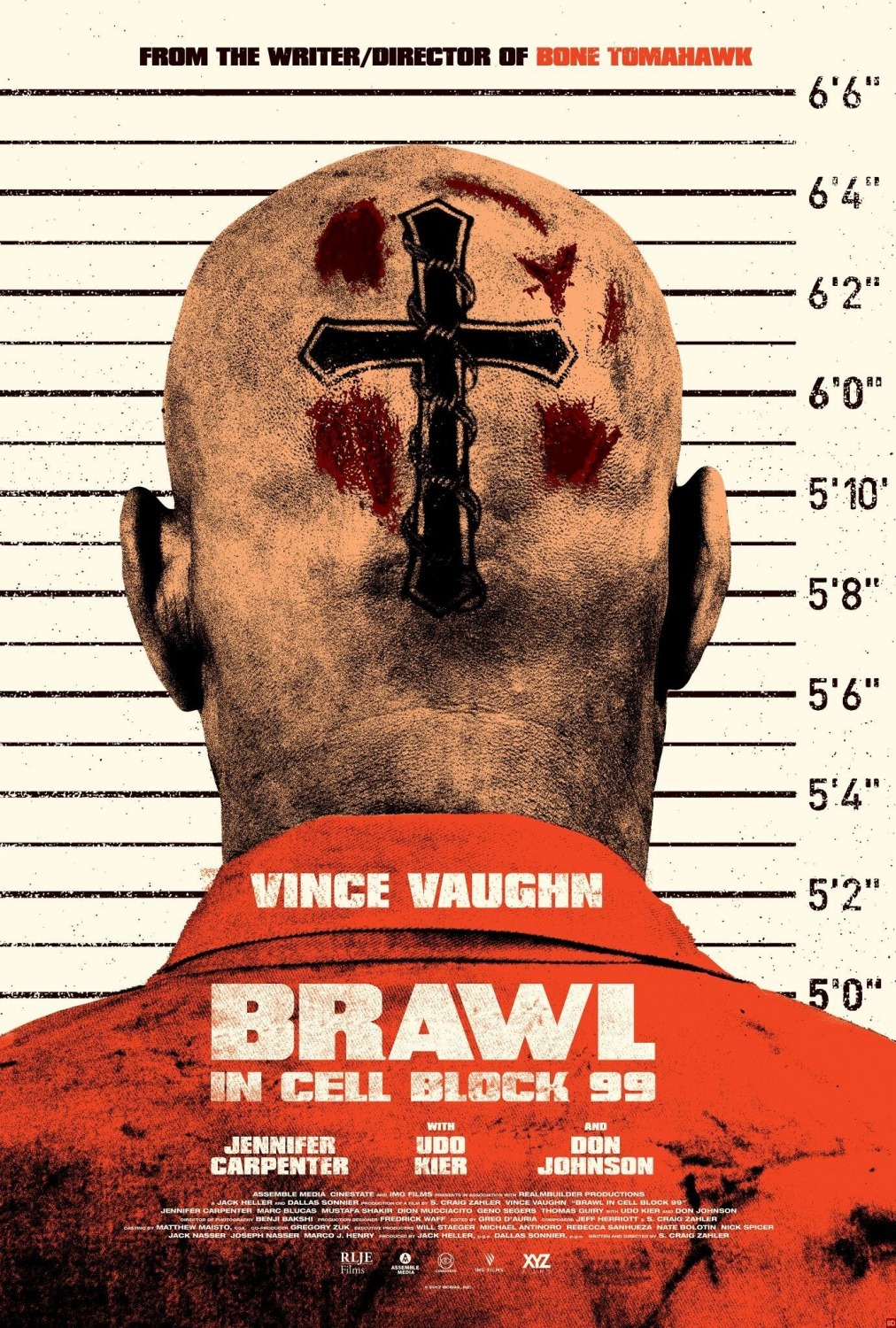
These posters are so fucking bad, they do the movie an injustice.
I was interested in the movie because of the rave reviews it had gotten and because of his previous debut feature: the western horror Bone Tomahawk. I didn't think an amazing amount of the movie upon first seeing it but have come to see the great parts about it because of the number of YouTubers who sing its praises.
Red Letter Media made a video that cemented the movie as unique and special in my mind, and encouraged me further to check out the directors' other work:
Finally, I was pushed over the edge by what I heard about Cell Block - it's a unique approach to violence and fighting in particular. This and Vince Vaughn as the machine carrying out these bloody deeds seemed so unlike anything I'd ever seen that I finally decided to check it out at the start of the Covid19 Lockdown.
This is much more the poster I think Zahler would
have chosen to represent his film.
First Impressions:
I loved the film, much more so than I thought I would. It was such an amazing movie-going experience, a very rare non-stop adrenaline ride, that I decided immediately to check out the other film that followed this as well as revisit that debut western of his. How could I not seek out more of this man's work if he made this pitch-perfect movie?
Zahler has his fingerprints all over it, the first thing you notice is a unique style. His film takes its time and almost like a book lets you soak in the scenes, be there with the character, while all the time moving the plot forward. I think Zahler cuts out any and all fat, and then pads out the film by making each major plot element stretched, letting the audience sit at that moment for a while and letting the tension rise.
Zahler started with novels, writing some highly acclaimed Western-Horrors before his Western-Horror movie debut. He has always been a writer and worked on some other Hollywood movies, but from what I've gathered about him in interviews and the journalism surrounding the director, is that he has always had trouble getting his films produced because of their difficulty to market to a mass audience. He has great confidence in his writing and believes that audiences will have a good time even if it doesn't immediately seem that way on the surface. This is the confidence I envy.
The movie works because it breaks down the main character until there is nothing left and with its perfectly aligned pieces gives him a clean and cathartic solution to all the problems stacked on top of him. It's an incredibly satisfying film, one that uses the torture and dark scenarios our character finds himself in, in a way that eventually pays off. So many films rely on the shock and dark nature of the source material to let the audience's morbid curiosity keep them hooked. Things like 12 Years A Slave or on the other end of the spectrum, torture porn movies. Those movies make us ask how much worse can things get? They tease things getting worse and then they do. Brawl does the same thing, but it uses its climax to release all the built-up tension to create a very rare moment of pure catharsis. The same emotion usually associated with a revenge film when the protagonist finally takes revenge.
And yet the movie has a very bittersweet and heartfelt conclusion, the character was hard done by, his situation unfair, and even though he did the unimaginable in the corner he finds himself in, he still doesn't get what he truly wants at the ends. Rather is able to give it to someone else. The ending is cathartic joy at seeing our character finally win, as well as a sense of great sadness, knowing that he will never be able to escape the deep hole that he's dug for himself.
The performances really help carry this ending as well, Vaughn is usually associated with comedy, but this is up there with the great comedy turned dramatic performances like Steve Carrell in Foxcatcher or Adam Sandler in Uncut Gems, one where the actor completely disappears and only the character remains. Vaughn proves himself to be a great talent here.
The violence and fight scenes are amazing to watch, something I've never before seen put on film in this way. They are brutally realistic and don't shy away from showing the audience the consequences of the blows. The camera doesn't cut away, preferring to take a seat a little further away, and camp there. It's a movie where when bones break you as an audience member cringe. The closest to seeing one of those videos where someone gets severely hurt in real life. They are some of the best fight scenes I've seen in a very long time, and like the rest of the film, it takes its time. They let the audience be there with the characters, like everything else in the film this makes us feel more invested and immersed.
The movie seems realistic but is still heavily stylized in some departments - with some over the top gore, especially towards the end, and the dialogue of course (which almost reminds me of Tarantino's work, albeit more Sharekspearean). This all works to support this as a pure movie though, the film is a movie and proud of it. It wants to entertain and that's exactly what it does. You can tell that Zahler loves film and puts his all into everything he makes.
I have toyed with the idea that I am spending far too much time on a film that hardly anyone has seen, the movie did not make a great amount of money and doesn't appeal to a very large audience. Yet through this I still believe the movies' artistic worth outweighs this, I believe that almost anyone who actually sat down to watch this film would have a great time, the film is just so perfectly constructed its impossible not to.
This video dives into why the movie went so far underground:
It's a video that not everything I agree on, especially the author's complete disregard for Blade Runner 2049, but most of what he says is very interesting and he makes a good study into why this movie didn't reach as large of an audience, or critical acclaim, as it probably should have.
I think it's an amazing movie and would love it if I could make something at this level. I doubt if I should take as much inspiration from Zahler's work as I instinctively want to, but I remind myself that every successful movie has its roots in smaller, not as widely known films and stories that the directors really loved.
I really love Brawl, maybe through the lens of my work it could be more palatable to people, maybe I can make something like Zahler that I would love, either way, the end product has the possibility to be something I'll be happy with and that's all that I should be aiming for anyway.
The Writing:
Brawl in Cell Block 99 has some of the best writing that I have seen in a very long time, not only does it have a nearly flawless structure and plot progression, but even the smallest details in dialogue are carefully considered and entertaining to listen to.
Movies often excel at either dialogue or structure, this one does both and seemingly effortlessly so. To help me analyze how Zahler wrote Brawl I looked at this Youtube Video by Rob Ager.
I could break it down on my own, but when someone else has done such a good job already it seems like a waste for me to go through all that time to come to the same conclusions, after all with this paper we want to get to the point where we are making things that represent our influences, not still be analyzing how they did what they did.
He breaks what Cell Block 99 does so well into 8 different steps, I think the first three best break down why the movie works on a structural and character level:
1) Character Background
Zahler gives his characters a good background of life experiences to pull from, they are hinted at throughout the picture and as the plot progresses the audience starts putting together a clear picture of what their personal histories must look like.
In an interview Zahler even says that he gave his actors character biographies, to help them add extra texture into their scenes, drawing from these secret character histories.
The lesson to take away from this is that it is important to give characters a history, something that helps explain why they do what they do.
2) Motives
One of the things that I think Zahler does best is giving his character believable and sympathetic motivations. Even when the deeds they do are criminal or unethical, the audience is always on their side. He does this by giving them relatable problems at home, things which anyone can relate to. Like Good Time by the Safdie Brother a lot of the time, we forgive characters' actions in his films because they are doing it for someone less privileged.
This is very important in Cell Block because of the horrifically violent actions that the protagonist carries out. In his follow up project Dragged Across Concrete Zahler displays a possibly even better set of character motivations, with him giving both sides of the law understandable and sympathetic causes.
This is very important in Cell Block because of the horrifically violent actions that the protagonist carries out. In his follow up project Dragged Across Concrete Zahler displays a possibly even better set of character motivations, with him giving both sides of the law understandable and sympathetic causes.
3) Intelligent Characters
The heroes and villains both prove themselves to be cunning, being shown to quickly pick up information about a situation or other people, outsmarting others or cleverly solving problems.
This seems like one of the harder things to do as a writer, but the writer is in control of all the story elements and a character being able to weave their way through them is just the writer allowing them.
Comments
Post a Comment